

Smart Ring vs. Smartwatch: Which Device Provides More Accurate Proactive Health Monitoring? | Safe and Sound
As the trend of proactive healthcare continues to grow, owning a smart wearable device to monitor daily physiological data is becoming a new standard for modern families. However, between the two most popular and widely used options - smart rings and smartwatches - which one is truly the optimal choice for more accurate proactive health monitoring?
1. What is the essence of proactive health monitoring with smart wearable devices?
 Image: Smart wearable devices help enable proactive health monitoring
Before diving into detailed comparison criteria, it is important to understand the true nature of modern digital health monitoring. Around the world, healthcare systems are rapidly shifting from a "treat illness after it occurs" model to a Value-Based Healthcare approach. This model places long-term quality of life and effective disease prevention at the center of care.
To realize this philosophy, wearable technologies have emerged to help people take a proactive approach to health management by continuously collecting physiological data 24/7. Both smart rings and smartwatches are equipped with PPGI (Photoplethysmography) optical sensor systems that emit light through the skin to measure changes in blood volume. Based on this blood flow data, AI algorithms analyze core vital indicators, including Resting Heart Rate (RHR), Heart Rate Variability (HRV), SpO₂ (blood oxygen saturation), blood pressure, and sleep cycles.
However, due to fundamental differences in wearing position, size, and design purpose, these two devices deliver entirely different monitoring values and user experiences for family healthcare.
Read more: [IMT Smart Ring: Vietnam’s First Proactive Health Monitoring Device with Dedicated Doctor Support]
2. How do smart rings and smartwatches differ in proactive healthcare?
2.1 Greater accuracy through an optimal measurement location
Although smartwatches have a longer history of development, smart rings currently hold a significant advantage when it comes to the sensitivity and accuracy of physiological data collection due to their wearing position.
- For Smartwatches: The device collects data from the wrist. This area has relatively thick skin, and blood vessels are located deeper beneath the surface. In addition, daily movements such as working, walking, or exercising can cause the watch to shift, creating gaps that interfere with sensor light signals and reduce the accuracy of heart rate and blood pressure measurements.
- For Smart Rings (such as the IMT Smart Ring): The device is worn on the finger, a location proven by medical research to have a dense capillary network that is closer to the skin surface. The sensor naturally fits snugly around the finger, enabling continuous and stable monitoring of pulse signals, blood pressure, and SpO₂ levels with higher clinical accuracy than measurements taken at the wrist.
2.2 Sleep experience and data integrity
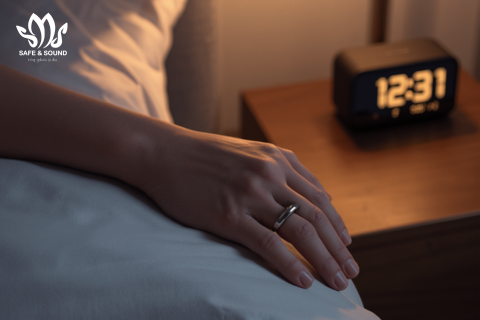
Image: Smart rings are comfortable to wear during sleep
Nighttime sleep is the "golden period" for collecting recovery-related physiological data and screening for serious health risks such as sleep apnea syndrome or sudden stroke. This is where design differences become particularly significant.
- Most users acknowledge that wearing a large, bulky smartwatch with a bright display while sleeping can feel uncomfortable, restrictive, and psychologically intrusive. As a result, many people remove their smartwatch before going to bed, causing interruptions in physiological data collection and reducing data integrity.
- In contrast, smart rings effectively solve this problem through their ultra-lightweight and compact design. By fitting gently and naturally around the finger, a smart ring allows users to forget they are even wearing a device. This exceptional level of comfort ensures that physiological data related to Deep Sleep and REM sleep for you and your loved ones is recorded completely and continuously without interruption.
2.3 Battery life that supports uninterrupted monitoring
Because smartwatches must power a large display while continuously handling notifications, calls, and entertainment functions, their battery life is often limited. Users need to remove the device frequently for charging, unintentionally creating gaps in health data collection.
Meanwhile, smart rings dedicate their energy entirely to operating biological sensors. By eliminating the display, next-generation smart rings typically achieve an impressive battery life of 5 to 7 days on a single charge. The flow of health data for your entire family can therefore be maintained continuously week after week, ensuring uninterrupted physiological data collection for proactive family healthcare.

3. Which is the smarter investment for your family: a smart ring or a smartwatch?
If your family is looking for a multifunctional device focused on technology features, communication, and outdoor fitness support, a smartwatch remains an excellent option.
However, if your goal is a specialized proactive healthcare solution that prioritizes more accurate cardiovascular metrics, blood pressure monitoring, and overnight SpO₂ tracking as valuable clinical data for physicians to help protect aging parents and loved ones, then a smart ring is the smarter investment and a forward-looking choice for the future of family healthcare.
Let technology strengthen family connections and protect your home. Do not wait until your body sends pain signals before seeking support. Connect your smart ring to the Safe and Sound expert ecosystem today to establish a reliable healthcare safety network for your entire family.

If you are looking for a comprehensive solution for proactive healthcare, managing both mental and physical well-being for yourself and your family, or if you would like to learn more about connecting personal biometric data with a network of healthcare professionals, please contact our team today:
24/7 Support Hotline: 0964 778 911
Facebook Page: SnS Clinic – IMT Institute
Or download and book a consultation through the Safe and Sound application to manage and track appointments anytime, anywhere.
Safe and Sound – A Member of the Institute of Medical Technology Applications (IMT)
Read More:
1. IMT Smart Ring – The Health Monitoring Device with Dedicated Doctor Support
2. How Accurate Is Blood Pressure Measurement with a Smart Ring? A Guide to Proactively Managing Systolic and Diastolic Blood Pressure at Home.
3. Smart Rings for Health Tracking: Why Are More People Becoming Interested in Their Body Data?
